Transcription intelligence · Secure bespoke systems
Your business is already recording everything. It's just not learning anything.
Your people already record calls, meetings and visits. The transcripts pile up in personal folders and go no further than a summary email. We build a bespoke platform around your business that combines those conversations with the data you already hold, extracts the intelligence you actually need, and feeds it into the systems where decisions get made — secured and compliant before it goes live.
Transcription intelligence is a bespoke build that joins the calls, meetings and visits a business already records to the data it already holds, and turns them into intelligence routed into the systems where decisions are made.
By Mike Hubbard · Updated 9 September 2026
Built by people who've sold, secured and shipped.
The picture
What's actually happening
Adoption is mainstream.
Use of AI in UK businesses with ten or more employees rose from around 12% to 35% in under three years.
Source: ONS, 2026
Use is shallow.
Firms that adopt AI use an average of 1.6 AI technologies. Most use goes no deeper than a meeting summary.
Source: ONS, 2026
The value isn't landing.
Three in four AI-adopting UK firms report better productivity. Just 12% report higher revenue.
Source: DSIT, 2026
Recording isn't the hard part. Doing something with it is.
The gap
Where the transcript goes to die
- Someone records the call. Someone else records the same call on a different tool.
- The summary goes out by email. The transcript goes into a personal folder nobody else can see.
- The CRM gets updated by hand, later, from memory, if at all.
- Action items are captured perfectly and owned by no one.
- Six months on, nobody can find what the client said about pricing.
- Meanwhile a copy of that conversation is sitting on a server you've never audited, under terms nobody read.
The transcript isn't the asset. The structured, owned, searchable record is.
The approach
Conversation in. Intelligence out. Action taken.
Capture, once.
Connect the tools and devices your people already use — call recording, meeting notes, a wearable in the field — so every conversation lands in one place instead of six.
Structure.
Extract what matters to your business in your language: decisions, commitments, faults, risks, figures, mapped to your fields, not a vendor's template.
Enrich.
This is the step everyone misses. On its own a transcript is just text. Combined with your ticket history, CRM, visit records, asset register or accounts, it becomes evidence. We join the conversations to the data sets that give them meaning.
Route.
Push the result into the systems where work happens: the CRM, the job sheet, the compliance file, the board pack. No re-keying, no second repository.
Learn.
Analyse across every conversation and every linked record. Trends, recurring faults, early warnings, the question that gets asked a hundred times a month — surfaced to the people who can act.
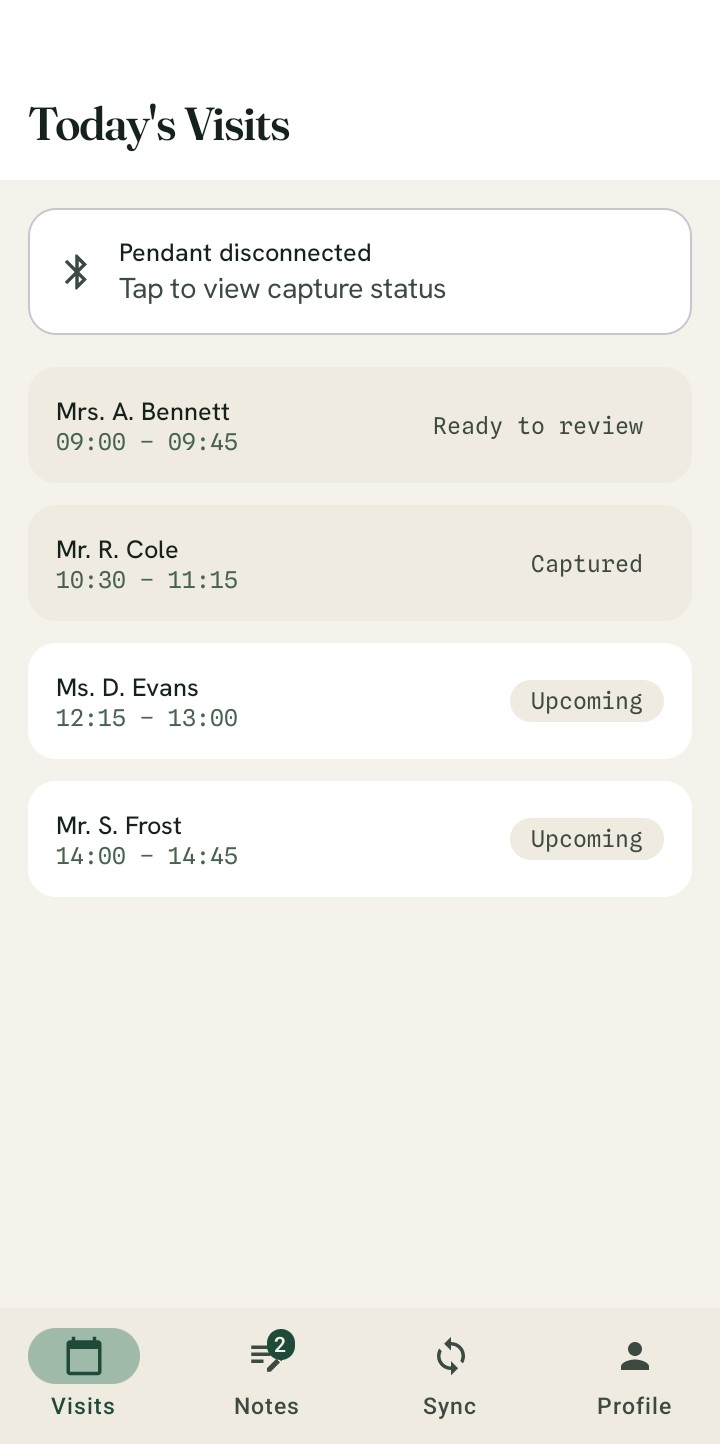
Bespoke to your workflow and your data. Built in weeks. Secured as standard.
The real work
Not another repository
A searchable archive of transcripts is the easy part, and on its own it is worth very little. The business value comes from deciding what intelligence your business needs, what other data gives the conversations meaning, and where the answer has to land to change a decision. That is discovery work, and it is the part we do with you before we build anything.
Care provider
What the conversations are
Ambient voice from home visits
What we enrich them with
Care plans, medication records, visit schedules, statutory outcomes
What the business gets
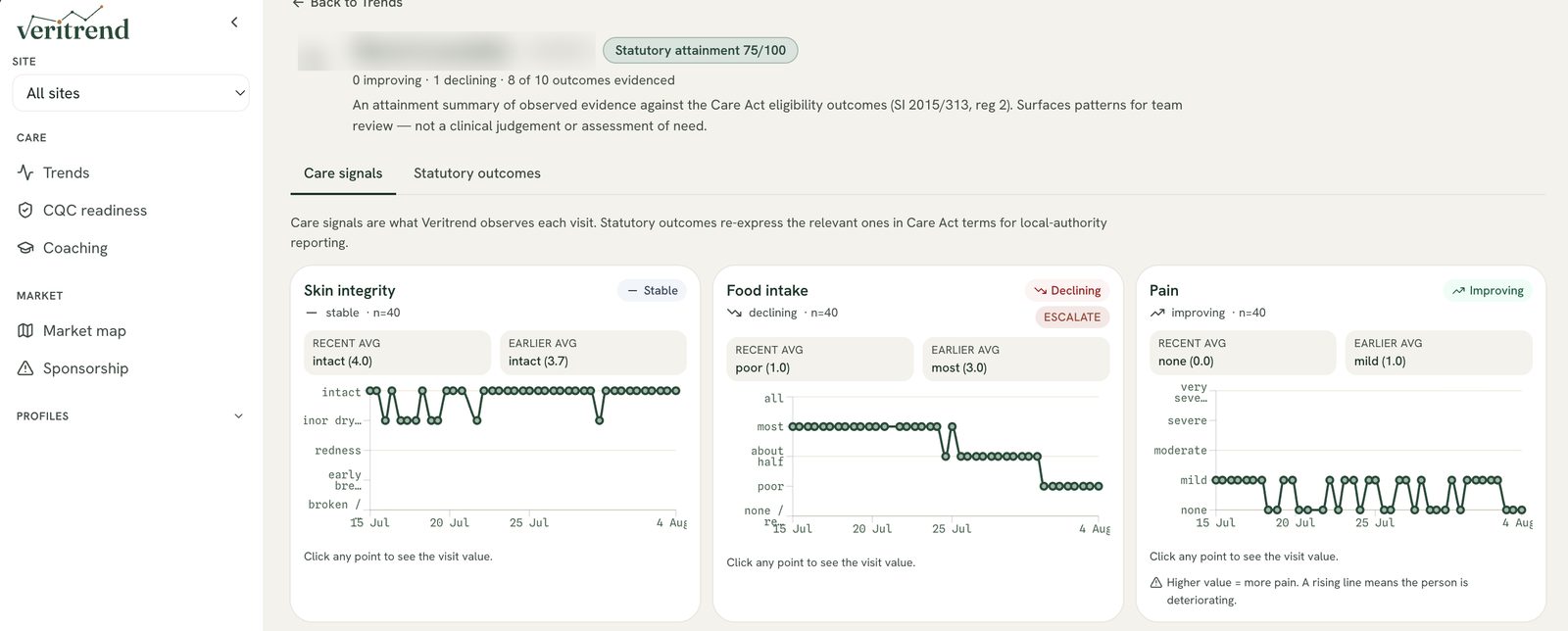
Trends across visits per person; decline flagged before a fall or admission; CQC readiness evidenced continuously. (This is what we built for VeriTrend.)
Support desk
What the conversations are
Recorded support calls and chat
What we enrich them with
Ticket history, product versions, known-issue list, engineer visit notes
What the business gets
Consistent faults that were being missed because each call looked like a one-off; root causes surfaced by product and batch; fewer repeat visits.
Sales team
What the conversations are
Recorded discovery and demo calls
What we enrich them with
CRM pipeline, quotes, win/loss, contract terms
What the business gets
Objections and competitor mentions by stage; deals that have gone quiet before they go cold; the CRM updated without the rep typing.
Field service
What the conversations are
Engineers' spoken visit notes
What we enrich them with
Asset register, service history, parts and stock, warranty terms
What the business gets
Parts failing early by model and site; warranty claims evidenced; the job sheet completed from the van, not the kitchen table.
Your row will be different. That is the point.
Outcomes
What it feeds into
Your CRM — updated after every call
Deal stage, next step, objections and named contacts written back automatically after every sales call.
Your compliance file — audit-ready notes
Structured, retained, retrievable file notes for regulated conversations, with the raw audio deleted once the record is approved.
Your care records — evidence across visits
Spoken observations from a home visit turned into structured records that show trends across visits, not once-a-year snapshots.
This is what VeriTrend doesYour product backlog — grounded in what customers said
Every mention of a feature gap, across every call, in one view.
Your board pack — themes surfaced monthly
Recurring themes from client and team conversations surfaced monthly, without anyone reading transcripts.
Your account team — early warnings before an account walks
Tone shifts and repeat complaints flagged across meetings before an account walks.
Security first
Consolidation raises the stakes.
This is what separates a bespoke build from a notetaker.
- A voice recording is personal data. A transcript is personal data. Both need a lawful basis, a privacy notice and a data-processing agreement.
- 71% of UK employees have used unapproved AI tools at work; 51% do so weekly. Only 32% worry about where the data goes. (Microsoft-commissioned Censuswide survey of 2,003 UK employees, October 2025)
- Free transcription tools typically process audio overseas, on terms that may permit training on your data.
- A central archive of every client conversation is a far bigger exposure than scattered personal notes. It needs role-based access, retention rules and a DPIA before it needs a search bar.
- Speech recognition makes more errors on Scottish, Northern and other British accents than on American English (peer-reviewed research). Bad transcripts make bad intelligence, so we build human review into the loop.
- Sector rules apply on top: FCA recording obligations in financial services, NHS ambient-voice guidance and DSPT in health and care, professional privilege in legal.
Every build ships with row-level security, secrets management, authentication hardening, a pre-launch scan and a written security statement you can show your own customers.
How the security wrap worksWhy us
Built, sold and secured by the same people
We've built it before.
We've sold with it.
We secure it properly.
FAQ
Common questions
What is transcription intelligence?
- A bespoke build that takes the calls, meetings and visits your business already records, structures them, enriches them with the data you already hold — ticket history, CRM, visit records, asset registers, accounts — and routes the result into the systems where decisions are made. It is not another repository.
We already use a notetaker. Isn't that enough?
- A notetaker produces a transcript that usually lands in a personal folder. The value is in the structured, owned, searchable record joined to your other data, pushed into your CRM, compliance file or board pack, and searchable across every conversation you have ever had.
Is it only for care providers?
- No. VeriTrend is our worked example in care, but the same approach applies to support desks, sales teams, field service and any business that records conversations and holds other data those conversations could be joined to.
What about the security and compliance of recording?
- Consolidating conversations raises the stakes: personal data, overseas processing and a larger central archive. That is why governance is the precondition — a DPIA, human review in the loop, and sector rules such as FCA SYSC 10A, NHS England ambient-voice guidance and DSPT — before anything goes live.
Bring us the conversations you're already recording.
Bring us the conversations you're already recording and the problem you can't solve with them. A short first meeting, an NDA, and we'll build a working draft in days at no cost. If it's not right, you walk away owing nothing. If it is, we build it properly, and it doesn't go live until the data handling has been assessed and documented.
- 1. ONS, Artificial intelligence in UK businesses: 2023 to 2026 (July 2026).
- 2. DSIT, AI Adoption Research (January 2026).
- 3. Microsoft-commissioned Censuswide survey, 2,003 UK employees (October 2025).
- 4. Graham & Roll, JASA Express Letters (2024); Torgbi et al. (2025).
- 5. FCA SYSC 10A; NHS England ambient voice guidance (May 2025); ICO guidance on lawful basis and DPIAs.